
Family recounts siege of West Bank home by Israeli settlers
Clip: 8/13/2026 | 5m 32sVideo has Closed Captions
Palestinian American family recounts siege of West Bank home by Israeli settlers
Israeli settlers laid siege to the home of an Palestinian American family in the occupied West Bank, sparking condemnation from the U.S. ambassador and an Israeli military response. Nick Schifrin spoke with Qusai and Ahmed Ridi from the house in Qusra, and Qusai’s brother, Loui Ridi, who helped translate this conversation.
Problems playing video? | Closed Captioning Feedback
Problems playing video? | Closed Captioning Feedback
Major corporate funding for the PBS News Hour is provided by BDO, BNSF, Consumer Cellular, American Cruise Lines, and Raymond James. Funding for the PBS NewsHour Weekend is provided by...
Family recounts siege of West Bank home by Israeli settlers
Clip: 8/13/2026 | 5m 32sVideo has Closed Captions
Israeli settlers laid siege to the home of an Palestinian American family in the occupied West Bank, sparking condemnation from the U.S. ambassador and an Israeli military response. Nick Schifrin spoke with Qusai and Ahmed Ridi from the house in Qusra, and Qusai’s brother, Loui Ridi, who helped translate this conversation.
Problems playing video? | Closed Captioning Feedback
Where to Watch PBS News Hour
PBS News Hour is available to stream on pbs.org and the PBS app.
Providing Support for PBS.org
Learn Moreabout PBS online sponsorshipAnd I'm now joined by Qusai and Ahmed Ridi, who join us from the house in Qusra in the occupied West Bank, and Loui Ridi, Qusai's brother, who joins us from Ohio.
Thank you very much.
Appreciate your time.
Loui, let me start with you.
You have been watching these events and this video from 6,000 miles away.
When did you realize that effectively your family were trapped?
LOUI RIDI, Palestinian-American: On Sunday, I got up in the morning.
As soon as I looked at my phone, I noticed the settlers building a tent literally in front of the house and setting a block on my brother and his son and neighbor family.
Well, it was a terrifying moment that -- seeing my own brother and his son would be trapped and under siege by the settlers, knowing what those settlers can do when someone get close to them or approach them.
They attack them, they beat them with the clubs.
And they have those ATVs.
They chase them.
They go behind them.
So I was in contact with my brother immediately, and he was -- he was fearing for his life.
He didn't know what to do.
He was alone with his son.
He said they cut off all supplies.
Now no one can go in or out of the house.
The only thing he could have done, and he did do that, he called the police immediately, and an hour later the police dispatched an IDF vehicle, and he had hoped that they would come and help him out.
And instead they went straight to the tent, and they conducted a prayer with the settlers.
and then they celebrated with the settlers, sat down with them on the same table.
And they were chilling and hanging out with them, and absolutely did nothing for my brother and his son on that day.
NICK SCHIFRIN: Qusai, let me ask you.
The Israeli military evacuated you this morning, but you have since returned to the house.
Do you have enough food?
Do you have enough water?
And what's going on outside?
Are the settlers and soldiers still right outside the house?
QUSAI RIDI, Qusra, West Bank, Resident (through translator): From Sunday until now, we are trapped.
They have banned us from accessing food and medicine.
Even the electricity and water is cut off.
We're forced to use solar energy to keep the lights on.
And yet we refuse to leave our house.
But, unfortunately, the solar power is not enough to power our homes.
We have no water.
We have wells.
These wells are not suitable for drinking.
But we had to drink from this water.
We have very limited food.
We don't have medicine.
And this is now a closed military area.
They have forbidden anyone to enter.
I mean, we have lived in terror and fear for a while.
We're in a very difficult situation.
We're asking the government and the institutions to help us and stand with us and protect us from these settlers, who are not human beings.
They are monsters.
NICK SCHIFRIN: And, Ahmed, from your perspective, what have you been feeling as you have had to deal with this?
AHMED RIDI, Qusra, West Bank, Resident (through translator): It's a terrifying feeling to be constantly surrounded by the locals.
It's dangerous.
You stay awake at night watching out to see if they will attack.
A lot of people throw rocks at us.
It's terrifying.
NICK SCHIFRIN: Loui, let me come back to you.
The U.S.
Ambassador to Israel Mike Huckabee last night called the settlers Israeli terrorists, and wrote: "Actions by those who carried out this horrific act of terror meant to intimidate and harass this family are disgusting."
What's your response to the ambassador's intervention?
LOUI RIDI: Well great to hear this, but what's more important what the ambassador said, it's really what's -- what's happening on the ground, the action.
We need this to be implemented to remove those settlers permanently, and not just a post on social media and then nothing happening on the ground.
As you -- we speak right now, that did not change anything on the ground.
NICK SCHIFRIN: And, Loui, I visited the West Bank earlier this year.
I have met other Palestinian-Americans who have been subject to settler violence, even killed, including 19-year-old Nasrallah Abu Siyam.
So what is happening to your family is not happening in isolation.
What do you think it says that even an American passport, frankly, cannot protect some of these Palestinians from this violence?
LOUI RIDI: Well, we contacted the U.S.
Embassy.
We contacted our local U.S.
representative in the Congress, and we have been trying to seek for help, because we know that everybody is a target in the West Bank, and sometimes the U.S.
passport doesn't protect you.
And that's why we are demanding to get protected and get safely into the house, outside out of the house, get supplies to the house, that we -- me and my family over there to live freely when I travel on my own hometown.
NICK SCHIFRIN: Loui Ridi and Qusai and Ahmed Ridi, thank you very much to all of you for joining us.
LOUI RIDI: Thank you for having us.
QUSAI RIDI: Thank you.
Thank you very much.

Baby elephant at National Zoo helps lead fight against EEHV
Video has Closed Captions
Baby elephant at National Zoo helps lead fight against deadly disease (4m 57s)
DOJ strips some naturalized Americans of citizenship
Video has Closed Captions
DOJ deploys tactic to strip naturalized Americans of citizenship (5m 23s)
How Trump's construction projects are costing taxpayers
Video has Closed Captions
How Trump's construction projects are changing Washington and costing taxpayers (8m 25s)
News Wrap: Earthquake death toll in Colombia tops 260
Video has Closed Captions
News Wrap: Earthquake death toll in Colombia tops 260 (5m 45s)
Teacher empowers her students to see themselves as art
Video has Closed Captions
Teacher empowers her students to see themselves as art (3m 23s)
Trump administration ends funding for Arctic climate report
Video has Closed Captions
Trump administration ends funding for Arctic climate report (6m 54s)
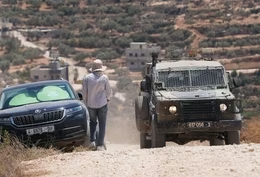
U.S. condemns Israeli settler siege of homes in West Bank
Video has Closed Captions
'Act of terror': U.S. condemns Israeli settler siege of Palestinian homes in West Bank (4m 33s)
Providing Support for PBS.org
Learn Moreabout PBS online sponsorship New Episode
- News and Public Affairs

Today's top journalists discuss Washington's current political events and public affairs.

- News and Public Affairs

FRONTLINE is investigative journalism that questions, explains and changes our world.
 New Episode
 New Episode
 New Episode
 New Episode
 New Episode
 New Episode

 New Episode
 New Episode
 New Episode
 New Episode
Support for PBS provided by:
Major corporate funding for the PBS News Hour is provided by BDO, BNSF, Consumer Cellular, American Cruise Lines, and Raymond James. Funding for the PBS NewsHour Weekend is provided by...