
New York Tripani Apple Farm
Clip: 4/20/2026 | 3m 54sVideo has Closed Captions
Forget New York City! A “Big Apple” tradition at this Empire State location is all about apples.
Forget New York City! A “Big Apple” tradition at this Empire State location is all about the tasty fruit.
Problems playing video? | Closed Captioning Feedback
Problems playing video? | Closed Captioning Feedback
America's Heartland is presented by your local public television station.
Funding for America’s Heartland is provided by US Soy, Sustainable Agriculture Research and Education, Rural Development Partners, and a Specialty Crop Grant from the California Department of Food and Agriculture.
New York Tripani Apple Farm
Clip: 4/20/2026 | 3m 54sVideo has Closed Captions
Forget New York City! A “Big Apple” tradition at this Empire State location is all about the tasty fruit.
Problems playing video? | Closed Captioning Feedback
How to Watch America's Heartland
America's Heartland is available to stream on pbs.org and the free PBS App, available on iPhone, Apple TV, Android TV, Android smartphones, Amazon Fire TV, Amazon Fire Tablet, Roku, Samsung Smart TV, and Vizio.
Providing Support for PBS.org
Learn Moreabout PBS online sponsorship>> Apples are a top pick for Americans when it comes to their favorite fruit, right alongside bananas and berries.
U.S.
apple sales in 2013 topped 2.4 billion dollars as consumers reached for dozens of apple varieties in their produce departments.
I mentioned at the top of the show that New York is one of the country's leading apple producers.
Early settlers planted apple trees in New York way back in the 17th century.
And for one New York farm family, the bright red fruit has long been an important crop.
♪♪ >> For Ben Trapani and his sons, growing and selling fruit is a passion rooted in the past.
>> I've lived on the farm all my life.
My parents, it was their farm.
And my grandparents, it was their farm.
They moved here in 1923, my grandparents.
And it's like a fourth generation farm.
It's in our blood.
It's what we do.
I couldn't see anybody in my family doing anything different.
>> The 86-acre family farm which sits in the Hudson River Valley about 80 miles north of New York City grows a wide variety of fruits, including peaches, raspberries, blueberries, plums and table grapes.
But, its mainstay is apples.
>> We grow approximately 19 different varieties of apples.
Seems like everybody has their special type that they like.
We try to grow the different varieties that are requested by the people.
>> And while the Trapani's have been growing produce here for decades, early records point to a farmer named Joseph Carpenter who worked this same land more than two centuries ago.
>> And I believe the date that he died was like 1766.
And it said, "First settler of this area, or of this land, and planter of this orchard".
So we know that this land has been farmed since the 1700's.
>> Scott Trapani is the heir apparent of the business.
He's applying his college education in agriculture to making the farm more productive, which includes growing smaller apple trees.
>> Are you gonna prune a small tree compared to a big tree?
You're going to put a lot less time into a small tree.
And you can see in these trees, they're just filled with apples.
>> If I need to come here and pick, I can get right to the middle of the tree.
A standard size tree, you can't do that.
So, it's just all around more efficient.
And you're going to get much better quality out of it.
>> The Trapanis stay competitive by growing more than just apples, and offer an unusual selection of fruits.
>> Gooseberries and currants, because a lot of people do not know about them.
And then we let people test it, try it for themselves.
And if they like it they'll come back and buy it again.
>> Over the years the family's fruit-filled road show has expanded to eight different farmers markets.
That interaction has delivered a loyal customer base for their popular produce.
>> It's nice to see the regulars that come in every week.
Sometimes I save some of the riper fruit for a couple of the ladies.
They bake with it.
I just give it to them because I'm going to throw it out anyway.
And usually they'll bring me a tart or a pie the next week.
It's just nice.
You form a bond with the people at the markets.
It's a nice feeling.
>> The Trapanis hope their visitors, and their customers, know how much the family believes it their product, and their craft.
>> Anybody that knows anything about farming, it's not an easy profession.
You really have to love it.
You have to have it in your blood.
If you don't have it in your blood, you're not going to make it.
>> Because it was always our dream, Ben and I, when we finally bought our own land, it was just like a dream come true for both of us.
So it's nice to see it moving on to the children.
♪♪
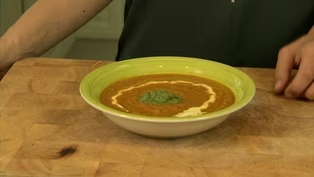 New
NewFarm to Fork Roasted Carrot Soup
Video has Closed Captions
Carrots are good for you – and tasty, thanks to this Farm to Fork carrot soup recipe. (6m 51s)
 New
NewVideo has Closed Captions
An Ohio farm family finds new ways to market their products to overseas consumers. (4m 26s)
 New
NewVideo has Closed Captions
Plant breeding scientists develop new, hardier species of crops. (2m 25s)
 New
NewVideo has Closed Captions
A father and son farming team brings new ideas to their Virginia operation. (4m 51s)
Providing Support for PBS.org
Learn Moreabout PBS online sponsorship
- Food
Christopher Kimball’s Milk Street Television
Transform home cooking with the editors of Christopher Kimball’s Milk Street Magazine.






Support for PBS provided by:
America's Heartland is presented by your local public television station.
Funding for America’s Heartland is provided by US Soy, Sustainable Agriculture Research and Education, Rural Development Partners, and a Specialty Crop Grant from the California Department of Food and Agriculture.