
New York Apple Harvest
4/20/2026 | 26m 30sVideo has Closed Captions
“Big Apple” harvest in New York. Ohio family sells crops overseas. Tasty new carrot soup recipe.
Forget New York City! A “Big Apple” tradition at this Empire State location is all about the tasty fruit. An Ohio farm family finds new ways to market their products to overseas consumers. Carrots are good for you – and tasty, thanks to this Farm to Fork carrot soup recipe. A father and son farming team brings new ideas to their Virginia operation.
Problems playing video? | Closed Captioning Feedback
Problems playing video? | Closed Captioning Feedback
America's Heartland is presented by your local public television station.
Funding for America’s Heartland is provided by US Soy, Sustainable Agriculture Research and Education, Rural Development Partners, and a Specialty Crop Grant from the California Department of Food and Agriculture.
New York Apple Harvest
4/20/2026 | 26m 30sVideo has Closed Captions
Forget New York City! A “Big Apple” tradition at this Empire State location is all about the tasty fruit. An Ohio farm family finds new ways to market their products to overseas consumers. Carrots are good for you – and tasty, thanks to this Farm to Fork carrot soup recipe. A father and son farming team brings new ideas to their Virginia operation.
Problems playing video? | Closed Captioning Feedback
How to Watch America's Heartland
America's Heartland is available to stream on pbs.org and the free PBS App, available on iPhone, Apple TV, Android TV, Android smartphones, Amazon Fire TV, Amazon Fire Tablet, Roku, Samsung Smart TV, and Vizio.
Providing Support for PBS.org
Learn Moreabout PBS online sponsorship>> Hi I'm Sarah Gardner.
We have a great show for you on America's Heartland this time.
We'll cross the country and an unusual farm in Ohio, serve up a carrot recipe quite different from those you might have tried before.
And have some "Red Delicious" moments in New York State.
New York City may be known as the Big Apple, but New York State is also one of the top apple producing locations in the nation.
For one New York family the bright red fruit has been an important part of their lives.
Come along to Ohio to meet a farming family taking a "global approach" in providing feed and livestock at home and abroad.
Everyone knows that carrots are good for you, but we all get tired of the same old dishes.
Well, Sharon Profis serves up a Farm to Fork recipe that is certain to delight your dinner guests.
And a young Virginian looks to harvest an historic American crop as he returns to the land and a new career in agriculture.
It's all coming up on America's Heartland >> America's Heartland is made possible by: >> America never stops.
Neither do the farmers and ranchers who call her home.
And as rural America grows further, Farm Credit will be there, just as we have for 100 years.
>> CropLife America, Representing the companies whose modern farming innovations help America's farmers provide nutritious food for communities around the globe.
>> The Fund for Agriculture Education.
A fund created by KVIE to support America's Heartland programming.
Contributors include the following: ♪ You can see it in the eyes of every woman and man.
♪ ♪ In America's Heartland, living close to the land.
♪ ♪ There's a love for the country and a pride in the brand.
♪ ♪ In America's Heartland, living close, ♪ ♪ close to the land >> Hi, thanks for joining us on this edition of America's Heartland.
We've often shared stories with you about farm and ranch families taking some very innovative approaches to making sure that their operations are successful.
Many farms today are diversified.
That's the reality for turning a profit when you're turning the soil.
For some, it's a combination of crops and livestock.
For the Surber family farm in Ohio, it's a more global approach to providing feed and livestock.
♪♪ >> Agricultural roots run deep in the Surber family, seven generations on this Ohio land.
>> Since 1802 when Jacob Surber first settled the land, and we've had a Surber on this farm ever since including today.
>> Raising crops has been a way of life for the Surbers for more than two hundred years.
But some twenty years ago the family began to diversify, involving themselves in other agricultural enterprises.
>> A natural offshoot was the purchase of a feed company for which John Surber had long been a sales representative.
>> We buy corn from local farmers.
And we grind it.
We mix it with the vitamins and minerals.
And then we haul it to the different farms.
>> And you looked to see which ones were hog farms and which ones were dairies?
>> Shawn Surber is the logistics manager at Premier.
>> Coming behind you, Jeff.
>> Shawn supervises the movement of 350 tons of feed each day.
>> This is a computer that makes all of our feed here.
It'll draw up each ingredient, dump it into a scale hopper where it is weighed, and then it goes down into our mixer.
After that it's ready to be loaded on a truck.
>> Premier also makes food for pigs.
That came in handy when the Surbers decided to add livestock to the mix.
>> Eleven years ago when we bought the business and we were looking for ways to expand, the opportunity to build a pig barn came up and it just seemed like it would be a good fit because that's what we done.
We made feed for animals.
>> The family's pork production operation has grown dramatically.
>> From 14 pound piglets, these hogs will grow to 270 pound animals over a six month period.
>> It's a pork production operation that involves almost everyone, including Shawn's daughter Brooklin.
>> They're really cute and you've to work with them to make them not scared so they'll be good mommas with their babies.
>> And in 2010, the family expanded their livestock efforts becoming certified to export animals overseas.
It's a project they call "Feed the World".
>> Feed the World is really an offshoot from ultimately what we do is help farmers each and every day, whether it be on our businesses from the feed side, the grain side, or now with raising livestock.
So you know, this is a way that we can not only touch things going on here in Ohio and surrounding states.
But now we can actually reach out to the world.
>> Connie, tell me about the isolation facility.
>> This hoop structure is part of our Feed the World exports that we bring cattle in, and they are required by the country that they will be traveling to, to stay here for a certain amount of days.
In this case these cattle were traveling to Turkey.
And Turkey has required that these animals stay here for 20 days.
And they're quarantined.
>> And you say 20 days for Turkey, but depending on the country, it could be any number of days.
Yes.
>> All of these agricultural enterprises provide the Surbers with the opportunity to continue a farming tradition that's already two centuries old.
>> From an opportunity standpoint, from a satisfaction standpoint I don't know of any other industry in the world that could be better.
And that's really what we all love about what we do each and every day.
>> And I'd like to say, for most people they get up, they go to work.
It's their job.
They come home from work.
It's not our job.
It's our life.
And, we love our life.
♪♪ >> Hogs make the list as one of the top five agriculture commodities in Ohio, alongside soybeans, corn, dairy products and eggs.
A male hog... called a boar can grow to weigh 500 pounds.
And watch what you say about pigs!
Unlike some humans, pigs don't overeat, they stop when they're full.
>> Family farming in America has seen a dramatic change in the past century.
Technology and mechanical innovation have, of course, prompted major changes, but family considerations also play a role in how and if family farmland is handed down from one generation to the next.
Choosing a career path for one young man meant time away from his family's farming tradition.
But his return to farming brought him back with new ideas.
It also impacted his relationship with his father in growing cotton and other crops, sustainably and successfully.
♪♪ >> Particularly in this area of the world, we are very much are Mother Nature's hands.
This wheat is screaming it needs to come out of the field.
>> Steele Byrum knows you can't rush nature.
That's just a fact about farming.
But not long ago, this Virginia native wasn't even sure about choosing this way of life.
After college, Steele got a well-paying job with a major food company.
But something drew him back to the soil... and to a family business stretching back four generations.
>> The generation gap between my grandfather and me, he could work harder than his neighbor and make a viable living.
My ability to make a living farming is going to be a lot more of outsmarting markets and being a step ahead of what's going on worldwide.
(Crosstalk) >> Being a step ahead... of nature, or of world commodity prices is one of the many things Steele's learning from his father.
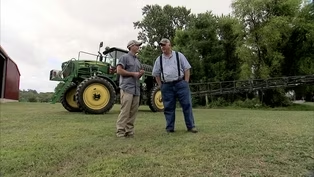
He's now growing wheat, cotton and soybeans on his farm just down the road from his dad.
Cecil Byrum says he didn't demand or even expect his son to return to farming.
But he admits to quietly rejoicing when it happened.
>> There's nothing that I know of that is more honorable than having a son that wants to do what you did to make a living.
I think it's very important because nobody's going to have a more vested interest in the future of a farm than a family member.
>> Today's a pretty typical day.
All of the morning's best-laid plans are quickly changing.
They'd hoped to harvest the winter wheat, but the seeds and the ground are still too moist from recent rains.
Instead, they'll spray some much-needed fertilizer on their cotton fields.
It's a crop that's making a comeback in Virginia.
The Byrums invested heavily in cotton after worldwide competition started impacting Virginia's peanut-growing industry.
It's a safer bet than corn during the years when the rain is scarce.
>> This area of the world, they say you're never more than ten days away from a drought.
We have very fertile, very productive soil, but it's very thirsty land.
>> Walk the fields with Steele Byrum, and you quickly discover some of farming's many challenges.
Varying soils with different water needs.
And, threats like this fast-growing "pigweed."
>> We can see some pigweeds starting to break ground here.
This pigweed is going to grow 26 inches tall and it's going to shade out your cotton and you won't even know there's a cotton field here.
>> For the Byrums, modern farming means going easy on the environment.
They practice no-till farming, where residue from the last crop is left on the ground to prevent erosion, provide more soil nutrients, and reduce evaporation.
>> And modern technology, like GPS positioning, means using no more than what's needed to feed the soil and fight pests.
It's called "precision agriculture".
>> There's nobody that has more of an interest in a safe, sound, secure environment than the farmers and the rural areas to protect their areas, protect it for our families, and for our neighbors.
♪♪ >> With all of farming's challenges, this father and son must share resources.
They've also learned this family's future requires consensus when tough decisions demand it.
And, it is strengthened by a closeness common to this way of life.
>> It really is a mixture of new ideas and old ideas.
It's the family thread that brings you back together, bonds you together.
>> Farming is a labor of love.
It's been good, it's been good for me, it's been good for my family life.
It's a huge responsibility, and I take a lot of joy and pride in trying to keep it going.
>> It's thought that early Egyptians were the first to grow cotton commercially.
But cotton was being grown in diverse locations from Latin America to India some seven thousand years ago.
Cotton is used in clothing, cattle feed, Q-tips and cash.
U.S.
dollars are 75% cotton, 25% linen.
♪♪ >> Well my name is Kent Bradford and my work is involved in seed biology, seed production and related to improving crop varieties for production in agriculture.
>> It is true that seeds are little miracles, that's certainly true.
>> This is a wild tomato species.
In a very real sense seeds are critical to our future.
And in a large fraction, Not all of our agriculture but a very large fraction of our agriculture depends upon being able to reproduce seeds annually.
>> Wow, this is nice.
The seeds that are used by farmers to grow crops have to be produced every year or at most every other year to provide good quality seed and efficient agriculture requires uniform crops that germinate quickly and establish quickly and grow rapidly.
We need to be improving crops because the environment, the tests, the markets and so on are changing all the time.
>> For example, the size of watermelons has shrunk recently from large watermelons that used to be the case to the small personal watermelons.
And that's all done by developing new varieties that appeal to consumers.
>> We have so many new tools that we didn't have in previous years.
In the last 20 years certainly our ability to understand the basis of traits that we want has improved enormously.
It's as if it's a GPS for breeders.
>> I think if someone is looking for a career in plant science, this area of plant breeding and seeds is a great place to be.
Its really the intersection between the technology and the practical aspect.
They way to think about seeds in agriculture these days, in a sense, they're the microchip.
They're the heart.
>> You plant a seed and that carries all of the traits, all the efforts that the breeders have put together.
And the more that we can do that, the less we have to add later.
The less fertilizer we have to add later, the less pesticide we have to use to control diseases.
The ability to now feed 6 and a half billion people is largely due to plant breeding.
Clearly as we go towards 9 billion people in the next 30 years, we're going to need to double food production again and we simply cant do that without improved varieties.
♪♪ >> When you head to the produce department, carrots are always easy to spot.
In the world of vegetable varieties, we all know that carrots are good for you and that bright orange color looks spectacular when you're setting out baby carrots and dips as an appetizer for your dinner party.
But have you run out of new ideas on why carrots should be on the menu at your house?
Well, Sharon Profis has some thoughts on carrots that might help.
Let's check in with her in our Farm to Fork segment.
♪♪ >> Today we're making carrot soup, but it's just not any carrot soup, we're going to enhance the flavor of the carrots and we're going to use the whole vegetable, form the tip all the way to the greens, so we'll get to the greens later, for now I'm just going to cut them off and set them aside.
Whenever I cook with carrots I like to remove the skin because it can be bitter, so I'd rather not risk it, just go ahead and remove it, and the carrot top.
At the store or at the farmers market you might see a variety of carrots; they don't just come in the color orange, there are purple carrots, yellow carrots and even multi-colored carrots.
>> They're beautiful in salads, but in this case since we're making a soup we'll stick with the orange variety.
It might go without saying but when you're shopping for carrots pick the ones that are the most brightly colored.
Because we're roasting the carrots for the soup they're going to be even sweeter than they already are, I love roasting carrots, I love sautéing them, it brings out their true sweetness and that's exactly what we're doing here.
To complement the carrot's sweetness I'm adding an apple, I've chosen Braeburn apples, basically any apple that has a sweet-tart flavor is going to be perfect here.
>> We'll also add a couple stocks of celery including the leaves, I feel like that's the theme here, you've got to use the whole vegetable, the leaves have a lot of flavor in them, especially celery leaves, it's like if the veggie was an herb that's what the greens taste like.
So two cloves of garlic and finally half an onion.
I basically have a Mirepoix here, onion, carrots and celery.
So just the rough slice, in they go, and we'll keep the seasoning very simple since we have a lot of flavors going on and we want to still taste the carrot, so just a pinch of salt, about half a tea-spoon of chili powder, about a quarter tea-spoon of pepper, and finally 1 to 2 table-spoons of olive oil.
>> Alright we'll put it on our baking sheet here.
I'm going to put this in the oven at 425 degrees for about 30 minutes until they're just starting to brown and ready to become a soup.
Like I said always keep the carrot top, so you can save them for a veggie stock or in this case we're going to turn them into a pesto, so we're subbing some of the basil with carrot tops, but first into the food processor goes walnuts and parmesan.
So put them in there, and we just want to grind these up first.
(food processor) The reason we do that is because the greens don't take as long to break down, now we can put in the carrot tops, that's from about 2 bunches of carrots and basil, so we still get that true pesto flavor, some salt but not too much because the cheese is salty, and pepper.
>> We'll give this a whirl and while it's going I'm drizzling in about a half a cup of olive oil.
(food processor) Perfect.
We'll set this aside and use some of this as a topping for our soup, it's going to be so beautiful and the rest of it you can keep in the fridge for pasta or anything else you want to use it for, for about a week or a week and a half.
>> At this point our veggies should be roasted, so we're going to remove them from the oven and make our soup.
These look and smell amazing, and this is how you want them, just starting to brown, soft enough to become a soup, and while they're still hot, just immediately transfer them to a food processor or a blender, and we'll add the veggie stock.
>> You can also use chicken stock if that's your preference, but I feel like with vegetable soup sometimes the chicken stock can take over a little bit so the veggie really lets the main ingredients shine.
There's no hard-and-fast rule about how much so I'll start with a little bit and see where that takes us.
Now this is beautiful soup.
Because carrots are packed with beta-Carotene, the thing that makes them orange, it comes out so beautifully when you blend it, so now I'm going to transfer it to this pot, heat it up on the stove, and then we'll be ready to serve it with our carrot top pesto.
>> Check out this beautiful warm bowl of soup that we still have to dress up a little bit.
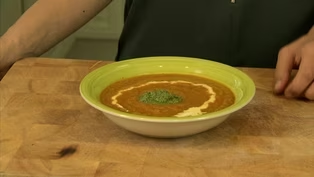
So I'll take a little spoonful of our pesto, oh..., the colors are beautiful, and I know you typically put cream in the soup when you blend it, but I prefer it as a garnish, it's a beautiful bright dish that looks like it came out of a restaurant but you made it in your own home, and now all that's left to do is eat.
♪♪ >> Ready for some carrot science when it comes to those bright orange vegetables?
Here's a fun fact: Some people claim carrots taste sweeter when grown in cooler weather.
Carrots... to protect themselves from freezing... convert some of their starch to sugar when growing in colder weather.
This helps prevent ice crystals from forming and prevents damage to the carrot's cells.
>> Apples are a top pick for Americans when it comes to their favorite fruit, right alongside bananas and berries.
U.S.
apple sales in 2013 topped 2.4 billion dollars as consumers reached for dozens of apple varieties in their produce departments.
I mentioned at the top of the show that New York is one of the country's leading apple producers.
Early settlers planted apple trees in New York way back in the 17th century.
And for one New York farm family, the bright red fruit has long been an important crop.
♪♪ >> For Ben Trapani and his sons, growing and selling fruit is a passion rooted in the past.
>> I've lived on the farm all my life.
My parents, it was their farm.
And my grandparents, it was their farm.
They moved here in 1923, my grandparents.
And it's like a fourth generation farm.
It's in our blood.
It's what we do.
I couldn't see anybody in my family doing anything different.
>> The 86-acre family farm which sits in the Hudson River Valley about 80 miles north of New York City grows a wide variety of fruits, including peaches, raspberries, blueberries, plums and table grapes.
But, its mainstay is apples.
>> We grow approximately 19 different varieties of apples.
Seems like everybody has their special type that they like.
We try to grow the different varieties that are requested by the people.
>> And while the Trapani's have been growing produce here for decades, early records point to a farmer named Joseph Carpenter who worked this same land more than two centuries ago.
>> And I believe the date that he died was like 1766.
And it said, "First settler of this area, or of this land, and planter of this orchard".
So we know that this land has been farmed since the 1700's.
>> Scott Trapani is the heir apparent of the business.
He's applying his college education in agriculture to making the farm more productive, which includes growing smaller apple trees.
>> Are you gonna prune a small tree compared to a big tree?
You're going to put a lot less time into a small tree.
And you can see in these trees, they're just filled with apples.
>> If I need to come here and pick, I can get right to the middle of the tree.
A standard size tree, you can't do that.
So, it's just all around more efficient.
And you're going to get much better quality out of it.
>> The Trapanis stay competitive by growing more than just apples, and offer an unusual selection of fruits.
>> Gooseberries and currants, because a lot of people do not know about them.
And then we let people test it, try it for themselves.
And if they like it they'll come back and buy it again.
>> Over the years the family's fruit-filled road show has expanded to eight different farmers markets.
That interaction has delivered a loyal customer base for their popular produce.
>> It's nice to see the regulars that come in every week.
Sometimes I save some of the riper fruit for a couple of the ladies.
They bake with it.
I just give it to them because I'm going to throw it out anyway.
And usually they'll bring me a tart or a pie the next week.
It's just nice.
You form a bond with the people at the markets.
It's a nice feeling.
>> The Trapanis hope their visitors, and their customers, know how much the family believes it their product, and their craft.
>> Anybody that knows anything about farming, it's not an easy profession.
You really have to love it.
You have to have it in your blood.
If you don't have it in your blood, you're not going to make it.
>> Because it was always our dream, Ben and I, when we finally bought our own land, it was just like a dream come true for both of us.
So it's nice to see it moving on to the children.
♪♪ >> We love it when you tune in to watch each week and we also love it when you connect with us at our America's Heartland website.
You'll find us at AmericasHeartland.org.
We have video from all of our shows, links to lots of other information about agriculture and of course our Farm to Fork recipes.
And don't forget you can connect with us on Facebook or check out our America's Heartland videos on You Tube.
That's going to do it for us this time.
Thanks for travelling the country with us on America's Heartland.
♪ You can see it in the eyes of every woman and man.
♪ ♪ In America's heartland, living close to the land.
♪ ♪ There's a love for the country and a pride in the brand.
♪ ♪ In America's Heartland, living close, ♪ ♪ close to the land >> America's Heartland is made possible by: >> America never stops.
Neither do the farmers and ranchers who call her home.
And as rural America grows further, Farm Credit will be there, just as we have for 100 years.
>> CropLife America, Representing the companies whose modern farming innovations help America's farmers provide nutritious food for communities around the globe.
>> The Fund for Agriculture Education.
A fund created by KVIE to support America's Heartland programming.
Contributors include the following:
 New
NewFarm to Fork Roasted Carrot Soup
Video has Closed Captions
Carrots are good for you – and tasty, thanks to this Farm to Fork carrot soup recipe. (6m 51s)
 New
NewVideo has Closed Captions
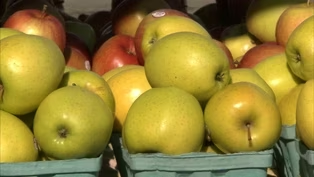
Forget New York City! A “Big Apple” tradition at this Empire State location is all about apples. (3m 54s)
 New
NewVideo has Closed Captions
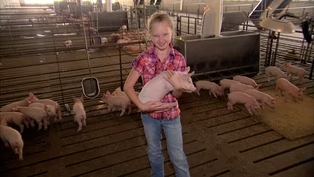
An Ohio farm family finds new ways to market their products to overseas consumers. (4m 26s)
 New
NewVideo has Closed Captions
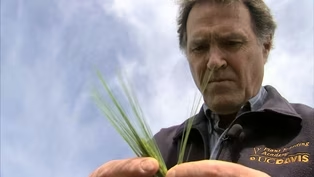
Plant breeding scientists develop new, hardier species of crops. (2m 25s)
 New
NewVideo has Closed Captions
A father and son farming team brings new ideas to their Virginia operation. (4m 51s)
Providing Support for PBS.org
Learn Moreabout PBS online sponsorship
- Food
Christopher Kimball’s Milk Street Television
Transform home cooking with the editors of Christopher Kimball’s Milk Street Magazine.





Support for PBS provided by:
America's Heartland is presented by your local public television station.
Funding for America’s Heartland is provided by US Soy, Sustainable Agriculture Research and Education, Rural Development Partners, and a Specialty Crop Grant from the California Department of Food and Agriculture.