
Freshwater | Parenthood
Season 44 Episode 7 | 52m 14sVideo has Audio Description
Animal parents must overcome freshwater’s constant changes.
Animal parents must overcome freshwater’s constant changes. A frog dad scales giant Amazonian trees with tadpoles on his back, while an elephant mom must choose between the safety of her baby and the quest for water and food.
See all videos with Audio DescriptionADProblems playing video? | Closed Captioning Feedback
Problems playing video? | Closed Captioning Feedback
Major support for NATURE is provided by The Arnhold Family in memory of Henry and Clarisse Arnhold, Sue and Edgar Wachenheim III, The Fairweather Foundation, Charles Rosenblum, Kathy Chiao and...
Freshwater | Parenthood
Season 44 Episode 7 | 52m 14sVideo has Audio Description
Animal parents must overcome freshwater’s constant changes. A frog dad scales giant Amazonian trees with tadpoles on his back, while an elephant mom must choose between the safety of her baby and the quest for water and food.
See all videos with Audio DescriptionADProblems playing video? | Closed Captioning Feedback
How to Watch Nature
Nature is available to stream on pbs.org and the free PBS App, available on iPhone, Apple TV, Android TV, Android smartphones, Amazon Fire TV, Amazon Fire Tablet, Roku, Samsung Smart TV, and Vizio.
Buy Now
Explore More Ways to Watch
Bring the beauty and wonders of wildlife and natural history into your home with classic NATURE episodes.Providing Support for PBS.org
Learn Moreabout PBS online sponsorshipMore from This Collection
This five-part natural history series explores the extraordinary strategies and adaptability that animal parents employ to give their young a head start in life. Narrated by David Attenborough.
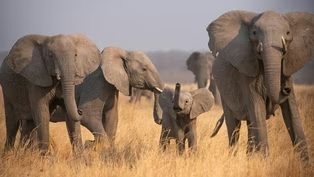
The Greatest Adventure | Parenthood
Video has Audio Description
Parenthood is the ultimate journey, full of danger. (54m 33s)
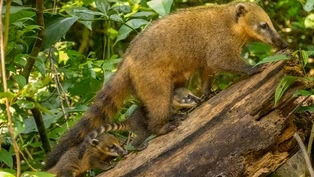
Video has Audio Description
See how jungle animal parents raise children by mastering their environment. (52m 22s)
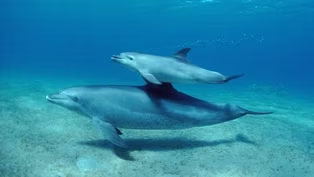
Video has Audio Description
Ocean parents must master dedication and intelligence to raise their young. (51m 50s)
Video has Audio Description
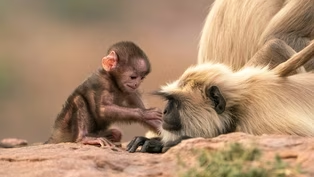
Animal parents must balance risk and reward to raise their young in grasslands. (51m 54s)
Providing Support for PBS.org
Learn Moreabout PBS online sponsorship♪♪ ♪♪ ♪♪ ♪♪ -Incredible ingenuity, dedication, and extraordinary teamwork.
This is what it takes to be a parent on our planet.
Meet the hard-working parents raising their families, doing all they can to protect... ...and provide for the next generation.
Discover the extraordinary ways animal parents navigate their world.
But a changing planet is forcing them to adapt.
Success for all parents has, perhaps, the greatest of consequences.
It ensures the future of life on earth.
This is "Parenthood."
♪♪ [ Squeaking ] ♪♪ ♪♪ -Deep underground, Amazon turtle hatchlings are waiting for rain.
They need just the right amount to soften the sand to dig themselves free.
Their mothers are waiting nearby in the river.
♪♪ Too little rain, and they will be trapped.
Too much, and they will drown.
♪♪ Life cannot exist without water.
But too much or too little can be disastrous.
And it can change in an instant.
If they are to succeed in spite of freshwater's constant changes, parents everywhere must adapt.
♪♪ In the Amazon's dry season, huge sandbanks appear.
In three months' time, the annual rains will return and submerge the banks once more.
Now is the giant Amazon river turtle's opportunity to lay eggs.
But she must get the timing right.
Other turtle mothers are gathering, waiting to lay their eggs.
♪♪ This is the biggest gathering of freshwater turtles on the planet.
The exposed banks remind the females that now is the right time to nest.
When one finds a place that suits her, she lays nearly a hundred eggs a meter beneath the surface.
♪♪ ♪♪ She has made her best guess as to the right time to nest this year.
Now she needs the rain to match her predictions.
♪♪ Six weeks pass.
The sun has baked the sand above the eggs into a protective crust.
But the rain clouds arrive... early.
In two of the past five years, early rain drowned most of the hatchlings.
♪♪ This is not good.
[ Squeaks ] ♪♪ As the rain falls, the river starts to rise.
♪♪ The babies have hatched, but they can't yet dig themselves free.
First, they must wait while they absorb part of their yolk sack.
The river continues to rise, and before the eggs have all hatched, some nests start to flood.
♪♪ The sand is getting more and more waterlogged.
They can't wait any longer.
♪♪ ♪♪ Three days after hatching, the baby turtles see sunlight for the first time.
But their mother's job is not done yet.
Waiting off shore, they call.
[ Turtle bleating ] It seems as if the mothers' song guides the hatchlings to safety amongst the adults.
♪♪ ♪♪ ♪♪ This year, many mothers got their timing right.
♪♪ And over two million hatchlings emerge.
♪♪ ♪♪ ♪♪ ♪♪ As the hatchlings join their mothers in the water, they add their voices to the chorus.
[ Hatchlings squeaking ] ♪♪ When freshwater flows are reliable, parents are able to give their young an excellent start in life.
♪♪ But even when water levels are stable, there may still be dangers for young animals.
[ Birds calling ] ♪♪ In a steaming swamp in South Carolina, hungry mouths gather... ...around the perfect home for a family of swamp canaries.
♪♪ These parents have chosen an excellent site -- a slim tree, surrounded by water.
Nests like these are difficult to reach from land, water, or air for anything but a small bird.
Useful to protect baby chicks... ♪♪ ...up to seven of them in a nest.
♪♪ ♪♪ As well as feeding their young, the parents keep their nests clean by removing the chick's droppings... ...in poo-bags.
♪♪ ♪♪ ♪♪ Caring for as many chicks as this is a two-bird job.
♪♪ ♪♪ ♪♪ A small nest may be safe, but chicks can quickly grow too big for it.
Leaving their tower will require them to take their first flight.
But the moat around their castle is now a major obstacle.
Predators lurk, waiting for an easy meal.
♪♪ It is at least 30 feet from the nearest tree.
Ready or not, time to leave the nest.
♪♪ ♪♪ The first hatched are the strongest, and they lead the way.
Later-hatched chicks are smaller and weaker.
♪♪ ♪♪ The water is no place for a chick, but there's nothing his parents can do.
♪♪ Although he's made it to the tree, he's still in danger.
But now, his parents can help... ♪♪ ...using rewards.
♪♪ ♪♪ Bit by bit, they coax him higher.
♪♪ Just a few more steps.
♪♪ There, now.
He's out of immediate danger.
His parents coax the rest of the chicks to safe hiding places all over the swamp.
They will continue to feed their chicks for five more weeks.
Large expanses of freshwater can be dangerous.
Small pools, like this one away from the main Amazon River, are safer for young animals.
The center is open and clear, and the edges provide plenty of hiding places.
Excellent for a family of cichlids -- provided that the parents can work together.
A carefully chosen rock in the center of the pool camouflages the eggs.
They are starting to hatch.
Wriggling tails, however, could attract attention.
♪♪ But the mother gently picks them up and puts them out of sight under a leaf.
♪♪ Father tries his best to help... ♪♪ ...but he's getting in her way.
♪♪ While mother is collecting more eggs... ...she turns around to find that her partner is at it again.
Caught in the act!
She clearly wants to finish the job herself.
♪♪ Working alone, mother gets every last wriggler tucked away safely.
♪♪ But she will need father's help when their wrigglers become swimmers.
Now both parents must guide their offspring to the edge of the pool where there's more cover.
First step -- navigate through a shoal of curimbatá.
It's a job that requires two adults.
♪♪ ♪♪ So now, it's father's chance to help.
♪♪ ♪♪ They made it.
All fry accounted for.
But they've hit yet another road-block.
Cichlids are very territorial, and this family has drifted into someone else's patch.
Their neighbor has turned dark, showing that he really wants them gone.
♪♪ Worse, he might also be hungry and regard the fry as a welcome snack.
♪♪ ♪♪ By coordinating their attack... ...they win the fight.
Finally united, they can continue to their new home.
It's exactly what they need.
The fry can practice swimming in the spring's bubbles, and there are plenty of hiding places.
♪♪ ♪♪ Together, the cichlids have made the most of all this pool has to offer their young family.
In the jungle, there are freshwater pools everywhere... ...in leaves, fronds, and holes in trees.
♪♪ But pools can have problems.
Big ones are likely to attract predators... ...and small ones are likely to dry out.
Parents must find the pools that are just right.
Meet Tinctorius, a poison-dart frog carrying his tadpole.
He needs a pool for it, and quickly.
This palm leaf may be convenient, but it's shallow and exposed, and could dry out before a tadpole could develop.
So, although he leaves one here, he continues his search for accommodation for his remaining three.
They are waiting in a leaf, which will dry out if left here much longer.
No time to waste.
One climbs immediately on to its father's back.
To spread his bet, he needs a different pool.
A hop, skip, and a jump, and he's found somewhere deeper, but without much food.
He can still do better.
Night falls, and he still needs to find two more pools.
[ Frog croaks ] A call echoes through the jungle.
A milk-frog with his tadpoles.
His loud calls are invitations to milk-frog females to lay their eggs in his pool.
Scientists believe that when a male Tinctorius hears the calls of milk-frog fathers... ...he may decide that the milk-frog's pool would suit one of his tadpoles.
The next morning, he sets out again with another tadpole on his back.
There's only one problem.
♪♪ The milk-frog's pool is over 60 feet up.
♪♪ Getting there with a tadpole on his back will be a long climb.
♪♪ ♪♪ ♪♪ Undeterred, he starts off again.
♪♪ ♪♪ It's a huge effort for the sake of just one tadpole.
♪♪ Made it.
And he's not bothered by the milk frog.
Not only will his offspring be safe here, it will also have plenty to eat... ...because, milk-frog tadpoles are good food for Tinctorious tadpoles.
But he can't rest just yet.
He still has one last tadpole which needs a pool.
♪♪ ♪♪ ♪♪ This dad will go to extreme heights to find the best pools for his tadpoles.
Parents can afford the pursuit of perfection where freshwater is plentiful.
However, where freshwater is rare, parents have fewer options.
The Namibian desert.
Here, there is very little water for miles around.
Except in the breast feathers of this Namaqua sandgrouse.
They are specially adapted to absorb an ounce of water.
And that enables his family to nest in remote corners of the desert.
But the chicks must drink at least once every day to survive.
So, father must fetch some for them.
♪♪ Almost 20 miles from their nest, a thin strip of green indicates standing water.
The male sandgrouse flies to this waterhole every day.
Here, he joins a flock of other thirsty sandgrouse.
But they all know better than to head straight to the water.
First, they settle at a safe distance.
Hidden among the rocks, the flock's many eyes scan for lurking threats.
Because when freshwater is rare, it can be used by some as a trap.
A lanner falcon, a booted eagle, and an African hawk-eagle have all taken up positions around the water hole.
♪♪ Despite the threats, some sandgrouse decide to take their chance.
Parents are vulnerable at the water.
They need at least five minutes in a pond to saturate their feathers.
The more cautious birds wait to see what happens to the first group.
♪♪ ♪♪ ♪♪ The lanner picks a target.
♪♪ ♪♪ She misses.
The booted eagle sees her chance.
♪♪ Together, they keep the flock in the air.
A spectacle visible from all around.
♪♪ Especially to a male, judging when it's safe to collect water for his chicks.
♪♪ Birds of prey seldom stop... ♪♪ ...until they make a catch.
♪♪ ♪♪ Even now, going alone could be fatal.
He must stick with the group.
There's no one left in the air.
If the predators are concentrating on eating, now could be the sandgrouse's opportunity.
♪♪ But they have overlooked someone.
The hawk eagle.
♪♪ To soak their feathers, parents must wade deeper into the pool.
♪♪ In their desperation for water, no one notices the eagle's approach.
♪♪ ♪♪ The father must hold his nerve.
He has not yet collected enough water.
♪♪ ♪♪ ♪♪ Missed.
♪♪ This father wings his way home, breast feathers fully loaded with water.
He will have to repeat this journey every day for the next eight weeks... ...until his chicks are ready to visit the waterhole for themselves.
For now, they can enjoy a good long drink.
♪♪ The water's presence here has enabled these parents to succeed.
However, when freshwater isn't reliable, the journey to parenthood itself can be laborious.
In the Caribbean, five miles upstream, lies a near-perfect nursery pool.
Food here is plentiful, and the water tumbling from the falls above keeps it clear and oxygenated.
After five months at sea, a tri tri goby has climbed a thousand feet to reach this pool and start a family.
His partner is ready to lay her eggs.
Pebbles, arranged in the right way, will alter the flow of the current creating good conditions for eggs.
♪♪ ♪♪ His activities attract attention.
Rival males are eager to take over his nest.
He will have to fight if he's to become a father.
♪♪ Good riddance, But one thing he can't fight is the weather.
[ Thunder rumbles ] A once-in-a-lifetime storm is brewing.
♪♪ ♪♪ ♪♪ ♪♪ Below the fall, the increase in water has turned the gentle flow into a whirlpool.
♪♪ ♪♪ The torrent has flushed him miles back downstream.
But he still has a chance to become a father -- if he can manage to climb once again to his nursery pool.
He hasn't done anything like this since he was a young fish.
And it shows.
He's a lot bulkier than when he was younger.
Climbing a thousand feet again won't be easy in his current condition.
Juveniles with boundless energy dart past him.
♪♪ Other adults try...and fail.
He pushes on, but the closer he gets to his pool, the stronger the current.
♪♪ ♪♪ ♪♪ With one final push... ...he makes it!
♪♪ But the pool is unrecognizable.
The storm has scattered all his carefully selected pebbles.
So, he starts work to create another nursery.
♪♪ If he is to become a parent, however, he will need stability.
When freshwater is not stable, parents must quickly adapt to ensure a future for their young.
Thailand.
These still waters should offer a secure foundation for the family of a lily trotter.
Long toes spread his weight across the lily pads, as he searches for insects amongst the greenery.
But he also has a special and urgent job.
He's building a floating nest!
A messy pile of pond weeds will have to do.
He must hurry back to his egg.
He misguidedly built his first nest in the busiest part of the lake.
Boats come so close that his egg risks being crushed.
He has decided to move to a quieter neighborhood.
Building a new nest was easy.
♪♪ Moving an egg without hands -- significantly harder.
Other lily trotters carry their eggs with their beaks.
This one has adopted a different method -- that takes a lot longer.
♪♪ ♪♪ At last!
Now he must settle his egg into this perfect new home in his perfect new neighborhood.
But in trying to avoid one threat... ...he hasn't noticed another.
Caterpillars have invaded the lake almost overnight.
♪♪ They don't have any predators here.
His precious chick has hatched -- into devastation.
♪♪ The insects that live amongst the lilies are harder to find, let alone catch.
And the caterpillars are completely inedible.
His chick needs food.
Once again, he will have to find somewhere better.
Lily trotters aren't built for this.
♪♪ But walking is their only option.
The chick can't yet fly.
♪♪ ♪♪ These are the last remaining lilies in the lake.
♪♪ It's not perfect, but there are plenty of insects for his chick.
Here, it can thrive.
♪♪ ♪♪ Lily trotters are not the only parents who must settle for the less-than-perfect in our changing world.
In East Africa, as the climate heats, rainfall is becoming less predictable.
[ Elephants grumble ] This elephant matriarch has kept her family alive throughout two years of drought.
She's leading them to the last flowing water she knows of -- the Ewaso Ng'iro River.
This is the only place for miles around which still has any water or food for grazing animals.
Until rain and good grazing return elsewhere, this is an oasis for the whole family.
♪♪ ♪♪ They haven't drunk for days.
This is a chance for a mother to demonstrate good trunk technique.
Her calf certainly needs the tutorial.
Step one -- get water into your trunk.
Step two -- get water from your trunk to your mouth.
♪♪ Sometimes it's easier to take a more direct route.
♪♪ These days spent in the cool, calm river are much needed relief for the whole elephant family.
♪♪ ♪♪ ♪♪ But the elephants are not the only travelers seeking refuge.
♪♪ ♪♪ ♪♪ The elephant matriarch decides that it's not safe enough for trunk lessons to continue.
Wild elephants and human beings usually avoid one another.
Each is too dangerous to the other.
In this drought, however, they have no choice but to share the river and the grass until rain returns.
♪♪ Weeks pass.
Herders and elephants crisscross the river in search of any grazing that remains.
So many mouths to feed takes a toll on the land, stripping it bare.
At last, the elephant matriarch senses something familiar on the horizon.
Rain is falling on the distant mountains that feed the river.
This should be a good sign.
But the hotter the air, the more moisture it stores.
♪♪ So, when, after a long, hot drought, rain finally comes, there is much more of it.
The distant deluge runs off the parched earth and becomes a flash flood.
The herds have been caught out... ...split apart by the sudden flood.
The herders have no choice but to cross and keep their livestock together.
♪♪ The elephant family has also been caught out -- trapped on the wrong side of the river.
♪♪ To follow the rain to fresh grazing, the matriarch must find a way to cross, while keeping the youngest safe.
♪♪ She tests the current with her trunk, assessing whether or not the youngest can manage the crossing.
♪♪ The flow seems gentle enough -- on this side.
But the current runs swifter near the opposite bank.
♪♪ ♪♪ As the current gets faster, the adults use their bodies to shield the calves.
♪♪ ♪♪ As the family enters the swiftest part of the river... ...a calf loses his footing.
♪♪ ♪♪ So far, the matriarch has kept her family together.
But now, she has a decision to make.
Press on toward fresh grazing... ...or turn back to keep her calves safe?
♪♪ She has decided.
The risks of crossing have become greater than the pangs of hunger.
♪♪ ♪♪ The matriarch has protected her youngest from this flood.
But as the world gets hotter, droughts and floods are becoming more intense... ...destabilizing life for parents everywhere.
Already, we are adapting to changing freshwater patterns.
♪♪ But we can choose to give the next generation a better future... ...a world with more reliable freshwater.
♪♪ What a gift.
♪♪ ♪♪ ♪♪ ♪♪ ♪♪ -To learn more about what you've seen on this nature program, visit PBS.org.
♪♪
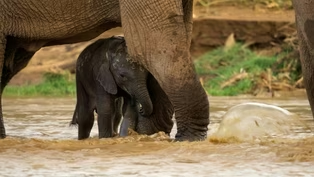
Elephant Mom Saves Baby From Flood
Video has Closed Captions
Clip: S44 Ep7 | 2m 52s | Trapped on the wrong side of a flooded river, an elephant mom must decide if it’s safe to cross. (2m 52s)
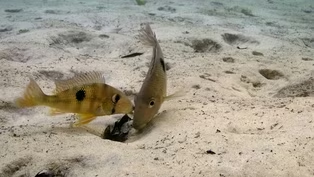
Fish Parenting 101: Mom vs. Dad
Video has Closed Captions
Clip: S44 Ep7 | 2m 33s | Cichlid parents must learn to work together to protect their young. (2m 33s)
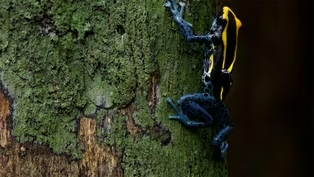
Frog Dad Goes to Extreme Heights
Video has Closed Captions
Clip: S44 Ep7 | 3m 8s | This frog dad goes to extreme heights to find the safest home for his tadpoles. (3m 8s)
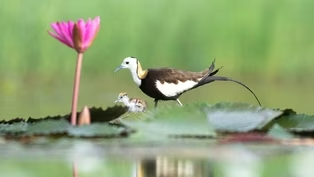
Preview of Parenthood "Freshwater"
Video has Closed Captions
Preview: S44 Ep7 | 30s | Animal parents must overcome freshwater’s constant changes. (30s)
Providing Support for PBS.org
Learn Moreabout PBS online sponsorship
- Science and Nature

Explore scientific discoveries on television's most acclaimed science documentary series.














Support for PBS provided by:
Major support for NATURE is provided by The Arnhold Family in memory of Henry and Clarisse Arnhold, Sue and Edgar Wachenheim III, The Fairweather Foundation, Charles Rosenblum, Kathy Chiao and...