
Dams: Spillways and Parachuting Beavers
Special | 5m 15sVideo has Closed Captions
Why would scientists drop beavers from a place to create dams?
Simply, a dam is a structure that blocks a waterway and allows the water to be used differently. There are natural and human-made dams. Learn how people use dams in their everyday lives and find out how scientists once airdropped beavers to improve backcountry habitat.
Problems playing video? | Closed Captioning Feedback
Problems playing video? | Closed Captioning Feedback
Science Trek is a local public television program presented by IdahoPTV
Major Funding by the Laura Moore Cunningham Foundation and the Idaho National Laboratory. Additional Funding by Sparklight, the Friends of Idaho Public Television and the Corporation for Public Broadcasting.
Dams: Spillways and Parachuting Beavers
Special | 5m 15sVideo has Closed Captions
Simply, a dam is a structure that blocks a waterway and allows the water to be used differently. There are natural and human-made dams. Learn how people use dams in their everyday lives and find out how scientists once airdropped beavers to improve backcountry habitat.
Problems playing video? | Closed Captioning Feedback
Where to Watch Science Trek
Science Trek is available to stream on pbs.org and the PBS app.
Science Trek
Science Trek is a place where parents, kids, and educators can watch short, educational videos on a variety of science topics. Every Monday Science Trek releases a new video that introduces children to math, science, technology, engineering, and math (STEM) career potentials in a fun, informative way.Part of These Collections
Technology
Technology is the practical use of science to make our lives better. Learn more.
View Collection
Providing Support for PBS.org
Learn Moreabout PBS online sponsorshipJoan Cartan-Hansen, Host: A dam is basically a structure that blocks a waterway.
There are natural and human made dams.
Find out more about dams and why scientists once parachuted beavers out of an airplane in the name of conservation.
[MUSIC] Student 1: What's that?
Student 2: A beaver dam?
Student 1: A dam?
I thought dams were ginormous concrete things.
Cartan-Hansen: Nope.
There are all kinds of dams, both natural and human made.
Want to find out more about dams?
(kids nod) People build dams for many reasons.
Some are used for flood control.
Some are used to generate electricity called hydroelectric power.
Others are used to store water for use in agriculture.
And for recreation.
And there are many different kinds of human made dams.
Concrete dams are made from, Student 2: Concrete?
Cartan-Hansen: That's right.
They can be an arch dam, which is better for steep, narrow valleys.
The arch helps transfer the weight of the water to the abutments or supports.
Or a concrete gravity dams like Grand Coulee in Washington.
The weight of all that concrete helps keep them in place.
There are embankment dams which have broad sloping sides.
These can be made of soil and rocks.
Student 1: How do they build a dam?
Cartan-Hansen: Take a look at how they built hoover dam in the 1930s.
To start, they re-routed the river.
One way to do that is to build a cofferdam.
A cofferdam is a small temporary dam with a channel to move water away from the construction site.
In this case, they used diversion tunnels.
Once the riverbed, or the bottom of the river, is dry, workers can begin building the dam.
Steel rods are bored into the bedrock.
Workers force grout, a liquid cement into the holes where the rods were set.
The grout seals the cracks and keeps water from undermining the foundation.
Embankment dams have a core of watertight material of clay or concrete.
Workers then build up the sides around the core and press the earth to make it firm.
A concrete dam is built of layers of poured concrete.
Dams aren't just a solid lump.
They have pipes and passages within.
Those pipes and tunnels connect the reservoir to the downstream river channel.
Sometimes these pipes can lead to a hydroelectric generating unit so they can create electricity.
Once a dam is finished, water from the river is allowed to back up creating a reservoir, or a giant lake.
To keep dams from overflowing, engineers build in spill ways.
These release water to keep the dam from overflowing or to send flood water downstream.
Today, Hoover Dam is the largest concrete arch dam in the United States.
But dams can create problems.
Fish can't get past them.
And that has caused salmon to become endangered.
And dams sometimes fail.
The most famous failure in Idaho happened in 1976 when the Teton Dam collapsed.
But in general, dams are safe, provide electricity, recreation, flood control and water for agriculture.
Student 2: But you said there are natural dams?
What are those?
Cartan-Hansen: Beavers are the best natural dam builders.
Beavers chew down trees and haul mud and plants and pack them between the sticks.
The dam is their home.
It's called a lodge and there are above water passages inside to keep the beaver family safe.
Water backs up creating a pond which gives them a place to find food and protection from predators.
But not everyone liked beavers.
Some didn't want their streams backed up.
And beavers were once prized for their fur and heavily hunted.
So, by the mid-1800s, the North American beaver was almost extinct.
But biologists have been working to restore beavers to their habitat and have had to use some pretty creative ways to get them into the back country.
Film Narrator: On the shores of Payette Lake are crates full of beavers, part of a shipment to be dropped in the primitive area by parachute from an airplane.
Students: An airplane?
Cartan-Hansen: Yup, back in 1949, conservation officers from the Idaho Department of Fish and Game wanted to set up new beavers in a primitive area.
Because it was too difficult to haul boxes of beavers so far, they decided to drop specially designed boxes with parachutes.
Thanks to conservation efforts, beaver populations have rebounded.
So, scientists think there may be as many as 10 million beavers throughout North America.
Human made dams play an important role in our lives, providing us with electricity, water, recreation and keeping us safe from floods.
And natural dams like beaver dams provide homes and food supplies for lots of different animals.
Dams change the environment, and that's both good and bad.
But without dams, life for humans and other creatures wouldn't be the same.
If you want to learn more check out the science trek website.
You'll find it at science trek dot org.
[MUSIC] ANNOUNCER: Presentation of Science Trek on Idaho Public Television is made possible through the generous support of the Laura Moore Cunningham Foundation, committed to fulfilling the Moore and Bettis family legacy of building the great state of Idaho.
By the Idaho National Laboratory, mentoring talent and finding solutions for energy and security challenges, by The Friends of Idaho Public Television and by the Corporation for Public Broadcasting.
Video has Closed Captions
Clip: Special | 1m 4s | Shall we blow up the dam in the wrong place? (1m 4s)
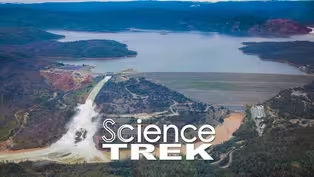
Dams: The Long and the Short of It
Video has Closed Captions
Clip: Special | 1m 4s | How tall is the tallest dam in the world? (1m 4s)
Providing Support for PBS.org
Learn Moreabout PBS online sponsorship New Episode
- Science and Nature

Explore scientific discoveries on television's most acclaimed science documentary series.











 New Episode

Support for PBS provided by:
Science Trek is a local public television program presented by IdahoPTV
Major Funding by the Laura Moore Cunningham Foundation and the Idaho National Laboratory. Additional Funding by Sparklight, the Friends of Idaho Public Television and the Corporation for Public Broadcasting.