
Dams: Power Up!
Clip: Special | 1m 4sVideo has Closed Captions
Learn how dams are used to make electricity.
More than 7% of America’s electricity comes from hydroelectric dams. Learn how the movement of water can be turned into electrical power and why dams may become a greater source of electricity.
Problems playing video? | Closed Captioning Feedback
Problems playing video? | Closed Captioning Feedback
Science Trek is a local public television program presented by IdahoPTV
Major Funding by the Laura Moore Cunningham Foundation and the Idaho National Laboratory. Additional Funding by Sparklight, the Friends of Idaho Public Television and the Corporation for Public Broadcasting.
Dams: Power Up!
Clip: Special | 1m 4sVideo has Closed Captions
More than 7% of America’s electricity comes from hydroelectric dams. Learn how the movement of water can be turned into electrical power and why dams may become a greater source of electricity.
Problems playing video? | Closed Captioning Feedback
Where to Watch Science Trek
Science Trek is available to stream on pbs.org and the PBS app.
Science Trek
Science Trek is a place where parents, kids, and educators can watch short, educational videos on a variety of science topics. Every Monday Science Trek releases a new video that introduces children to math, science, technology, engineering, and math (STEM) career potentials in a fun, informative way.[MUSIC] Joan Cartan-Hansen, Host: More than seven percent of America's electricity comes from hydroelectric dams.
Dams create electricity using stored water.
Dams store water from rivers and spring melt into reservoirs.
Dam managers then allow water to flow through a long pipe called a penstock.
From the top of the dam to the bottom.
The falling water spins blades in turbines.
Those spinning blades are connected to a generator.
Those generators use magnets and copper coils to create electricity which is sent out on power lines.
Some rivers also have specially designed turbines to capture the power of moving water to create electricity.
But dams and turbines do change the course of rivers.
And that can be deadly for fish like salmon that need a free flow to migrate downstream.
Hydroelectric power is considered a green source of energy because it doesn't require the burning of fossil fuels.
Most dams in the United States don't generate electricity, but scientists say they could be a potential new source of power.
For more information about dams, check out the science trek website.
You'll find it at science trek dot org
Video has Closed Captions
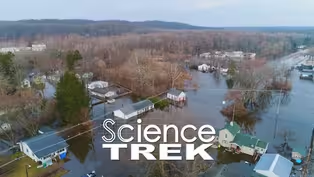
Clip: Special | 1m 4s | What happens when a big dam fails? (1m 4s)
Providing Support for PBS.org
Learn Moreabout PBS online sponsorship New Episode
- Science and Nature

Explore scientific discoveries on television's most acclaimed science documentary series.










 New Episode

Support for PBS provided by:
Science Trek is a local public television program presented by IdahoPTV
Major Funding by the Laura Moore Cunningham Foundation and the Idaho National Laboratory. Additional Funding by Sparklight, the Friends of Idaho Public Television and the Corporation for Public Broadcasting.