
America Made with Love, Part 2
Special | 56m 55sVideo has Closed Captions
Discover the ingenuity, vision, and masterful talent of some of our most extraordinary artisans.
Discover the ingenuity, vision and unparalleled talent of some of the nation’s most extraordinary artisans. Whether building wooden surfboards, reviving the art of neon signs, shaping the perfect cowboy hat, or crafting sails the old-fashioned way, these makers embody the very essence of American innovation and dedication.
Problems playing video? | Closed Captioning Feedback
Problems playing video? | Closed Captioning Feedback
America Made with Love, Part 2
Special | 56m 55sVideo has Closed Captions
Discover the ingenuity, vision and unparalleled talent of some of the nation’s most extraordinary artisans. Whether building wooden surfboards, reviving the art of neon signs, shaping the perfect cowboy hat, or crafting sails the old-fashioned way, these makers embody the very essence of American innovation and dedication.
Problems playing video? | Closed Captioning Feedback
How to Watch Made With Love
Made With Love is available to stream on pbs.org and the free PBS App, available on iPhone, Apple TV, Android TV, Android smartphones, Amazon Fire TV, Amazon Fire Tablet, Roku, Samsung Smart TV, and Vizio.
Buy Now
♪ Narrator: America... ♪ a wide open landscape where artisans use their creativity to push boundaries.
I love building things, putting things together.
Man, voice-over: Well, I can do things with steel that you can't do with any other medium.
Narrator: From coast to coast, modern-day explorers are honoring tradition and forging their own paths with the spirit of independence and dedication.
Man, voice-over: So it was, like, a thing where I was like, "Holy smokes, man, let's go.
I'm here."
Woman, voice-over: I think absolutely the biggest thing is to be able to see your product in action.
That's the best.
That makes it worthwhile.
Narrator: They are honoring their nation's past and setting a course for its future with their hands and their hearts.
Woman: Ha ha ha!
Woman, voice-over: The biggest secret to making anything is love.
If you don't put your love into it, it shows.
♪ ♪ Narrator: America, a nation defined by its many cultures, traditions, and voices, all blending together, creating a symphony heard across every part of this vast country.
♪ Bristol, which straddles the border of Tennessee and Virginia, is the birthplace of country music.
All-time greats like the Carter Family and Jimmie Rodgers launched their careers here.
♪ Of course, those legendary acts would never dream of taking the stage without one of these--a guitar.
Henderson, voice-over: I'm Wayne Henderson.
I'm a guitar maker from Grayson County, Virginia.
[Filing] Narrator: Wayne has been making guitars for about 60 years.
If it all goes back to his passion for playing music.
Henderson, voice-over: Well, I got started making guitars mainly out of necessity, I guess.
I played guitar since I was 5 and never had a very good guitar, got into making guitars to try to have a better guitar.
Narrator: Wayne made his first guitar at 14 from pieces of a dresser drawer.
As he kept on building his own guitars, word of his talents soon got around to other musicians in the area.
Henderson: So next thing I knew, people were bringing me guitars and things to be repaired and fixed, and every time they would bring me a good one-- you know, a nice one-- to work on, I would try to study how it was made.
♪ Narrator: Today's guitars can be traced back thousands of years to ancient instruments like the lute.
Modern-looking guitars begin to appear in 15th-century Spain, and by the 19th century, the modern, 6-string guitar had become the norm.
That paved the way for guitar makers around the world to put their own spin on this instrument, including the old Martin guitars that inspired Wayne Henderson.
Henderson: And if I can get them to sound pretty close like those old guitars did, I'm very happy with the way they sound.
Narrator: Wayne's not the only one who's happy with the distinctive sound of his guitars.
He's made more than 900 of them for clients such as country music star Brad Paisley.
Henderson: Most of the woodworking I can do in 3 days, and it takes me a couple of days to put the finish.
It's a process that takes some time to do.
[Band saw whirring] Narrator: Today Wayne is making his 932nd guitar.
♪ He starts with high-quality planks of imported wood, which he cuts, sands, and refines.
♪ [Blows] ♪ Narrator: He heats up and bends what will become the sides.
Henderson, voice-over: You always got to be careful because that side could break, and that happens sometimes.
♪ Believe it's bent.
♪ Narrator: He attaches the pieces of bent wood together and puts them into a mold to set.
♪ Wayne adds the kerfing inside the outer shell.
♪ These strips of wood shore up the guitar's structure.
♪ Henderson: It's real, real important stuff because it fits right in the corners of the guitar where the sides and top and back are glued together, and it's a little extra reinforcement.
Narrator: Before going any further, Wayne taps in the serial number with a hammer his brother gave him decades ago.
An awful lot of guitars have been stamped with this hammer right here.
♪ Two's a little bit low, but shows it's done by hand, and not some sort of a machine or a computer.
♪ Narrator: The back is glued onto the soundboard and sides.
Henderson: You put it in this frame because this thing is exactly the size the guitar is supposed to be.
I believe that's-- looks pretty good.
[Planing] There's all sorts of places on the guitar that are easy to break or come apart, so the little things like this braces it and makes it hold up better than it would without it.
♪ [Blowing] Narrator: Some pieces are structural.
Others, like the rosette which will decorate the soundhole, give this guitar a little extra style.
♪ Henderson: OK.
It looks pretty good.
Narrator: Wayne shapes the final pieces.
I go to this old fingerboard I use for a pattern, so I know the end of it out here.
[Band saw whirring] Narrator: He makes the neck, which will affect the instrument's tone.
♪ He adds the frets-- thin, metal strips a guitar player will use to change the pitch of the strings.
I'm not a mathematician enough to tell you exactly why and how that that worked.
[Filing] I know there's got to be in the right place.
Yeah.
Narrator: It's time to put all the pieces together.
♪ Looks like it fits pretty good.
♪ Got a nice, deep tone, and that'll be a good-sounding guitar, I think.
♪ Feels real good.
I'm real pleased with it.
Narrator: All it takes is a few finishing touches, and this guitar is ready to strum.
Henderson, voice-over: You're always happy if somebody likes your work, you know... ♪ and that might be the most enjoyable thing, seeing somebody get your instrument that you'd put an awful lot of work in and hear somebody put it to use.
♪ Narrator: While Wayne loves playing music, there's one thing he loves even more.
I can't think of anything else I'd rather be doing, you know, than to being in here in the shop working and making, making sawdust.
Yeah.
I love my job, for sure.
♪ ♪ Narrator: West of Virginia sits Kentucky, a state known for its bluegrass, its horse racing, and its signature drink-- bourbon.
Over the years, the making of bourbon has evolved from an underground market run by bootleggers to a $9 billion industry.
♪ This sweet spirit can be made anywhere in the United States, but 95% of it is produced right here in Kentucky.
You know, Kentucky is bourbon.
Bourbon is Kentucky.
I mean, there's no ifs, and, or buts about it.
♪ Narrator: Legend has it, bourbon was born here back in 1789, when a Baptist preacher accidentally aged his whiskey in charred oak barrels.
♪ The likely truth is that European immigrants heading west into Kentucky found the rye they had made whiskey from was harder to come by, so they experimented with corn instead and created bourbon.
For local families like the Neelys, distilling alcohol is a tradition that goes way, way back.
Man, voice-over: So we started making it legally here at the distillery in 2016, but my family's been making it illegally for 11 generations.
I watched my dad and Grandpa make illegal down those mountains as a young boy.
Royce: I've actually got my grandfather's original bootlegging car.
It's a '55 Bel Air we drive down here and let people take a look at.
Narrator: Royce had a vision for a different kind of business, one that was totally above board.
Royce: So I wrote the plan up for this distillery around 2014.
I took it to my father, and we haven't looked back since.
♪ Narrator: Making bourbon always starts with the grains-- mostly corn.
Kentucky's fertile fields are well-suited to this crop.
Royce: We wanted the most clean, pure grains that we can get.
It's going to have dirt in it, could have bugs in it.
This cleaner is going to clean all that out of there.
♪ Narrator: The grains are ground into small pieces and blended with lots of Kentucky water.
♪ This mineral-rich water is great for distilling bourbon, ♪ Royce: And the reason why is, that calcium and magnesium is optimum for creating environment for that yeast to be able to survive in that alcohol-rich mash.
Narrator: The mash is heated in this 600-gallon tank.
Royce: So now that we've got our grains mixed up in here with our water, we're going to be able to start the cooking process.
Narrator: Cooking helps break down starches.
As the mash cools, another grain-- such as rye, wheat, or oatmeal--is added.
Malt barley is put in, too, which helps turn those starches into sugars.
[Clanging] Finally, the mash is put into a fermenter along with yeast.
♪ This mixture sits for several days as the sugars ferment into alcohol and carbon dioxide escapes.
♪ After being moved to pot stills, this liquid is distilled 3 times to concentrate the flavor and help remove impurities.
♪ Roy tastes the unaged bourbon, known as white dog, to see if it's ready.
Royce: If you want to be a great distiller, it takes both art and science.
You can't have too much of either one.
Narrator: The white dog is poured into new oak barrels with charred inner walls, where it spends years aging.
That char imparts its brown color and unique flavors as the white dog finally becomes bourbon.
This particular bourbon is going to stay in here for anywhere between 6 to 8 years.
♪ Narrator: This bourbon was aged for 5 years, then put in a French wine barrel to age some more for added color and flavor.
Royce, voice-over: So it's a Kentucky straight bourbon whiskey finished in a Chateau Rieussec Sauternes barrel.
Cheers.
♪ Narrator: Once the bourbon passes the taste test, it's bottled for sale.
That's when Royce's sister Haylee pitches in, too.
Royce, voice-over: You know, it's Neeley Family, that's a sign of quality.
Narrator: That commitment to quality and to family affects everything they do here.
It's a good day when you're filling barrels.
Royce, voice-over: We're one of the only distilleries where the family distills in a distillery that was built by the family.
You don't ever see that anymore today.
♪ Narrator: Stained glass-- this age-old art still dazzles with striking designs and eye-catching colors.
♪ From grand cathedrals to the halls of political power, many of these stained glass windows are now centuries old, and modern-day artisans are keeping this craft alive.
♪ I'm Jed Boertlein.
And I'm Jacob Boertlein.
We are stained glass craftsmen.
From Washington, DC.
♪ Narrator: The Boertlein family has been making stained glass for over 100 years, going back to Jed's grandfather.
The fruits of this family's labor can be seen all over Washington, DC.
Jed: We've done a lot of work at the Capitol, White House grounds, museums, just about every church in this area.
I mean, it's a great feeling.
Narrator: The origin of stained glass is unknown, but it's likely the first colored-glass objects were made by the ancient Egyptians and Mesopotamians.
The use of colored glass in windows took off during the medieval period, especially in France and England, and was later used in cathedrals all across Europe.
♪ Nice.
Narrator: Today Jed and Jacob are working on a new window for a local church.
Using a rough sketch from the church's priest, Jed and Jacob developed it further.
Jed: At this point, we are just looking for general trace lines, nothing too detailed.
Jacob: We got the sketch from the artist, just came in the mail today.
Narrator: They can go back and forth with the client for months... Jed: Father should love that.
Narrator: trying to get the design just right.
I think we've captured just about everything he's looking for.
I think so.
Narrator: Once the design is set, Jed and Jacob lay out a full-sized paper drawing.
♪ They choose pieces of colored glass to match.
Jed, voice-over: We buy red glass, blue glass, white glass, purple glass, and then the glass is, of course, all hand-painted, treated, fired in a kiln, and we end up with a finished product.
♪ Narrator: The glass has to be cut out like pieces for a puzzle.
My father always says, "Listen to the glass."
You have to know the glass that you're dealing with, and you have to know how hard that glass is because all the glass is different.
Narrator: They paint on some final details, like faces, hands, and wings.
Jacob: Oh, it's looking great.
Everything's fitting perfectly, exactly what we want.
♪ Narrator: The final result is a single stunning work of art.
♪ Jed, voice-over: Knowing that something my son is working on will be there for the next 200 or 300 years, you know, it certainly fulfills you, and it's a sense of accomplishment.
Jacob: I see myself doing this for a long time, you know, plan on having children, too, so, you know, we'll have a fifth generation.
[Both laugh] ♪ Narrator: The Midwest is known for growing crops in its many acres of open fields, but it's also a place that's been fertile ground for creativity and imagination, especially here in the Windy City--Chicago.
♪ Neon signs-- they're bold and brilliant with radiant designs that pitch more than just a product, and they look and feel like catching lightning in a bottle.
Aguilar, voice-over: I'm Miguel Aguilar, master neon artist from Chicago.
♪ I've been making neon signs for the last 30 years.
I picked it because it was, like, a challenge because it involved the arts, and I've been doing arts all my life.
Narrator: Miguel--or Neon Mike, as some call him-- lends a magical artistry to neon.
Aguilar, voice-over: I prefer neon because it's a welcoming light.
[Blows] It's the night light.
It's the nighttime.
It's the sign of the times.
It'll always stand out.
Narrator: Neon signs have a long history, one that stretches back and forth across the Atlantic.
Neon gas was first discovered by British chemists in 1898.
Around a decade later, some Americans figured out how to use this new element to light a colored sign.
♪ Soon after, a French engineer refined that concept so that he could mass-produce these signs, which lit up Paris and the world.
By the 1950s, the Chicago area was aglow with neon, with signs installed by experts like Miguel's uncle Ray.
♪ Aguilar: He learned neon, took a class, passed it, and came out making neon signs, so he pretty much lit up his own town and, you know, just flourished from there.
♪ Narrator: Miguel's uncle brought him on as an apprentice, sparking a lifelong passion for a young man in search of a creative outlet.
Aguilar: That moment there was like, "Wow."
[Sighs] ♪ Man, it was crazy.
I mean, you're talking about light bulb going on, you're talking about a neon tube going on, so it was like a thing where I was like, "Holy smokes, man, let's go.
I'm here."
♪ Narrator: Miguel's uncle had strict rules about only making letter signs in the shop, so Miguel designed his own art projects on the side.
Aguilar: I was, like, creating cool stuff and just, you know, trying to take it to the next level and picking up the torch and carrying it.
Narrator: Miguel has been on a journey of neon-fueled discovery ever since.
Aguilar, voice-over: It's not like a job where you just, you know, do the same thing 24/7.
This is a real cool thing because you're always making something new.
You're not doing the same things.
Narrator: His shop is a neon wonderland aglow with inspiration and packed with all the tools he needs to ignite his colorful creations.
Aguilar, voice-over: It runs through all the art and all the things that are going on in the world, and I pretty much collect a lot of old memorabilia signs that I show, and I do it because it's cool.
Narrator: Now Miguel plans to make a new Art Deco style creation: an iconic symbol of America-- an eagle.
Aguilar: We're going to do the pattern here, and then we're going to do the ruby red, and then we're going to use the purple, and then we're going to make the eyes.
♪ Narrator: Miguel has to shape the glass tubes to match the design.
Aguilar, voice-over: You want to heat up the glass evenly-- that's the key-- and then you got to get the mental picture in your head, and then you start bending the glass.
♪ Aguilar: There you go.
All right.
Here's the beak.
♪ Now we are going to make the eyebrows.
♪ Narrator: The glass starts to collapse as it heats up, so Miguel blows into the tube to keep it open.
♪ Aguilar: All right.
♪ Narrator: Once the pieces of glass are shaped, they have to be fused together... ♪ along with the electrodes.
If there's even a slight gap, gas will escape, and the sign won't light up.
♪ Aguilar: OK.
There's that part there, so we got to reheat the glass up, no big deal, but if you do this, you'll be sailing.
You'll be happy.
♪ OK.
Narrator: He heats up the tube to sterilize it.
Aguilar: We're going to hook it up to-- It's called bombarding.
We are going to put gas inside the tube.
Time for the high voltage, and she's getting hot, so now we're pumping it.
OK.
Narrator: After the tube cools, he pumps in the neon gas, ties the tube onto a frame, and connects the electrodes.
Aguilar: So it's all going to be one continuous lead, one current flowing through the sign.
♪ I think it turned out very beautiful.
It just, you know, really warms my soul up and makes me very proud and happy that I designed pieces like this.
It's a good feeling, all that all wrapped up in one good art piece, you know, that's made with love.
♪ Narrator: Shoes-- some are practical, while others are works of art, and the style you choose can say a lot about who you are and where you're going.
Wills: I'm Alexandria Wills, and I'm a shoemaker from Chicago.
♪ I've been making shoes for about 12 years now, and I started my business when I was 19.
Narrator: Over the years, Alexandria Wills has produced more than a thousand pairs of custom-made shoes.
Wills: I actually make men's shoes, women's shoes.
I do boots, sneakers, heels, slip-ons, slippers, literally every kind of shoe you can think of.
Narrator: Alexandria had always loved making things-- origami, pottery, clothing.
Then she discovered shoes.
Wills: A big reason why I got into shoemaking was because I saw this kind of lost art.
I found it so fascinating, so I wanted to bring that to people, at the same time, express myself through the art of shoemaking.
Narrator: Humans have been wearing simple footwear for at least 40,000 years.
The earliest leather closed shoes go back more than 5,000 years.
For a long time, people mostly wore straight shoes, but by the early to mid 1800s, an innovation in shoemaking led to left and right shoes becoming more popular.
Today Alexandria will make a pair of high heels.
After drawing a design, she puts tape around the last, foot-shaped plastic mold.
And that allows me to get proper measurements, The toe shape, the toe box, the instep, this curve in the back of the heel... ♪ so-- ♪ Does it look like a shoe yet?
Narrator: She uses the tape to create a pattern that she traces onto the leather.
So this is going to be the 2-D pattern that came from the 3-dimensional shoe last, and I'm going to wrap it around the shoe last.
Narrator: She cuts out the leather... ♪ attaches the edges with glue, and hammers them together.
♪ Cool.
That is ready to go.
Narrator: She carves out the leather for the sole.
♪ It's so thick that I need this giant tool to cut it.
♪ Narrator: She uses something called the toe puff to shape the pointed toe... ♪ [Heat gun whirring] and adds the shoe's upper material.
♪ Yeah.
You just want it to look really pretty at this point because this is what people see.
Narrator: At last, this pair of shoes is done.
Wills, voice-over: I feel like I get the most joy out of that finished piece, and I just like sitting back relaxed after all that hard work and looking at how beautiful it is.
♪ ♪ Narrator: For thousands of years, people have cherished leather for its beauty, durability, and comfort, especially when it comes to making things like shoes, belts, and wallets.
Phil Kalas and Dan Cordova are the founders of Ashland Leather Company here in Chicago, where they craft handmade wallets and billfolds.
Kalas: When you look at our products, you can really tell that there was a human behind the process of making it.
To me, it feels very relatable.
Narrator: Chicago was once a major producer of leather, with more than 200 tanneries.
♪ Phil and Dan use leather from Chicago's last remaining tannery.
Kalas, voice-over: Really local, we buy the leather next door, bring it here, do everything here, and ship it out the door from the same location.
Narrator: The process begins with choosing the right piece.
♪ Cordova: We picked this leather because it has a very, very nice shine and color to it.
I do a visual inspection of the leather just to see if there's any, like, blemishes or any scars or anything like that that I don't want to include, so this right here looks pretty good.
Narrator: The perfect piece is cut with a hydraulic press and steel die.
♪ This wallet is hand-sewn to create the pockets and slots.
♪ A quick sand, a bit of trimming... Kalas, voice-over: After all that's done, it's ready to go.
Narrator: prized possession that Phil and Dan call the Fat Herbie, ready for cash, cards, and maybe even a picture.
♪ Just north lies Wisconsin.
♪ [Cuckoo cuckoo cuckoo...] Narrator: They've been keeping time for hundreds of years: cuckoo clocks-- playful, whimsical, carefully built with hourly reminders that it's time for something to happen.
Galinski, voice-over: I'm Bill Galinsky.
I'm a master clockmaker from Milwaukee, Wisconsin.
♪ Narrator: Bill has been repairing and making clocks for more than 50 years.
His love of clocks goes back to childhood.
Galinsky, voice-over: My father had bought me a cuckoo at 6 years old at a rummage sale.
That was the start of my clock career, and it just got into my blood.
[Chiming] Narrator: Bill has made a wide range of classic cuckoo clocks just like the one he got as a kid.
Galinsky: This one I made right around 2001.
Narrator: Cuckoo clocks were likely born in Germany's Black Forest region in the mid 17th century.
Farmers carved the pieces for them during their long winters.
Galinsky: The first cuckoo clocks were actually called lovebird clocks.
They had two different, a male and a female, calling to one another, and so that's how the cuckoo started.
Narrator: Centuries later, the technology behind these clocks remains virtually the same.
This is what makes a cuckoo clock cuckoo.
These are the pipes and the bellows.
[Cuckoo] What happens is, the wind comes out at a certain speed to cause a whistle.
The depth of this tube, some are hollow, and some are solid to the bottom, and that will affect the tone.
[Cuckoo] [Chiming] Narrator: Bill has created his own popular series of hunting- and fishing-themed cuckoo clocks.
[Chiming] He's made even more elaborate and playful timekeepers... [Cuckoo cuckoo...] like this.
Galinsky: The chickens are passing by in the hayloft, one for each hour.
The cow is kicking the milk pail in the farmer's hand.
The weathervane spins with the pig, and the goat goes through the wall, and the board hits the old lady in the henhouse.
What this one does is, the guy saws with the articulated arm.
One guy is up on top kneeling on roof boards, and the building inspector that's never happy comes to the window and pounds his fists.
Narrator: One of his greatest creations is this skyscraper-styled clock.
It was inspired by New York's Chrysler Building, and it took more than a year to make.
Galinsky, voice-over: 90% of this clock is built by me by hand.
[Chiming] Narrator: What Bill calls the Forever Clock is worth about half a million dollars, and he knows it'll still be ticking long after he's gone.
Galinsky: This clock would probably need a rebuild in about 300 years instead of a normal 35-to-40-year range.
This is one of the highlights of my career.
[Chiming] Galinsky, voice-over: The pleasure I get out of making clocks is designing them myself in my head, and then it's brought to fruition.
I absolutely love my job.
♪ Narrator: Every dawn when the sun rises, Maine is the first state to be kissed by its rays.
♪ With its many miles of coastline, sailing is a favorite pastime here.
Its open waters are a magnet for seafaring vessels with strong sails to harness the wind.
♪ I am Robin.
I'm Susan.
We are sailmakers... From Maine.
♪ The sailing community here is pretty diverse.
There are some people that have little, tiny boats.
There are some people that have much, much bigger boats.
This is people's fun, so we're dealing a lot with some dreams, you know, and making that come true and helping them enjoy their time on the water.
Narrator: Bohndell Sails first opened its doors in Maine in 1870.
3 generations of that family ran it before Susan Chace and her husband Bob took over.
♪ In time, they brought their daughter Robin on board, too.
Payson: So I used to be a competitive alpine ski coach, but I actively make the choice to be part of this family company because I do appreciate the opportunity to be here and making the sails.
Narrator: Sailing ships have navigated the water for thousands of years.
Early vessels had sails likely made from animal skins.
By the 1800s, sails were woven from cotton.
Most sailmakers today use manmade materials, like polyester.
Payson: So sail fabric is special because it needs to withstand certain elements, like UV, sunlight, and also the stress of the wind as it pushes on the sail over time.
♪ Narrator: The exact dimensions of each sail are plotted out on a large swath of fabric.
Payson: That's it.
♪ Narrator: Instead of cutting the fabric with machines, here, they do it the old-fashioned way.
That's a cut.
Ha ha ha!
♪ Fabric is expensive.
We just try to nail it the first time.
♪ Narrator: The sail's edges are treated with a hot knife.
We've got to melt it just a little tiny bit on the cut edge so it doesn't fray over time.
Narrator: Every sail is a 3-dimensional shape made of several pieces that allows for maximum air flow.
The curved lines, so making sure everything is lined up will give us a nice, smooth shape when the sail is in use.
Narrator: They sew the pieces together from what they call the pit so that the sail can lay flat on the ground, and they use what's known as a 3-step zigzag.
Payson, voice-over: And this creates a really strong stitch, and it's important to have a strong stitch during this part of the process when we're seaming up the sail so that the sail will last for a long time.
Narrator: The new sail is seaworthy.
Chace, voice-over: So we're pleased with how this sail came out.
It's going to suit the boat really well.
Great job.
Thank you.
Narrator: Each sail takes an average of 30 hours to create.
The Chace family makes over a hundred a year.
They've got no plans to slow down.
♪ Chace, voice-over: Absolutely the biggest thing is to be able to see your product in action and to have a customer come in and say, "Wow.
My boat sails so much better than it did before."
That is-- that's the best.
That makes it worthwhile.
♪ ♪ [Clanging] Narrator: They are magicians of metal, shaping wrought iron and steel through the searing heat of fire and imagination.
♪ I'm Doug Wilson, blacksmith from Maine.
♪ [Hammering] ♪ Narrator: Doug has been a blacksmith for almost 50 years.
Wilson, voice-over: It's just really satisfying for me to be able to conceptualize in my mind and then draw carefully something and then make it manifest as a physical object in steel.
[Clang clang] Narrator: The ancient craft of blacksmithing was first practiced in Mesopotamia thousands of years ago.
Early blacksmiths forged everything from weapons to tools.
These artisans still use traditional techniques to create tools or decorative ironwork.
Wilson, voice-over: In my work, there's no such thing as good enough.
It's either the way I wanted it to be or it goes back to the fire or into the swamp, you know?
♪ Narrator: Today Doug is working on a wildflower-inspired candlestick, sketching out the design.
♪ 9 3/4 inches right there.
Narrator: With his vision in mind, he works the coals until he gets a bright yellow-orange flame hot enough to shape steel.
3,100 degrees Fahrenheit is how hot the fire gets, hot enough that it makes steel look like a Fourth of July sparkler, and it actually burns up.
Hot iron.
Narrator: Doug pivots to the anvil with the red-hot steel and hammers the pieces together.
♪ Wilson, voice-over: So we got 3 different elements that are going to be joined together with a forged weld so it looks organic.
Narrator: He starts to taper the metal, bending it into shape.
So I'm rounding the stem of this up.
♪ Narrator: He brings the steel back to the fire to shape the finer details, including the blossom and the petals.
♪ Wilson, voice-over: Put it, the hot bar, between the two legs of the U shape and lean on it or pull or push, and the steel bends.
♪ As long as it glows, I can bend it without damaging it.
♪ Narrator: Doug's wildflower is in full bloom.
Wilson: I made drawings of it to see if it was really going to work the way I thought it would, and--look at that--it did.
That's great.
[Insects chirping] ♪ Narrator: In the Lone Star State of Texas, outside of Dallas, lies the little town of Decatur.
If you ever visit this place, there's a good chance you'll meet a cowboy.
They are iconic, standing tall in the American imagination, riding on horseback, herding cattle, and, of course, wearing one of these.
Man, voice-over: When you think of a cowboy, you think of a cowboy hat first.
You know, there's boots and saddle, all that, but the very first thing the majority of people think about is that hat.
I'm Jeff Biggars, and I'm a cowboy hatmaker in Texas.
♪ Narrator: Before Jeff became a hatmaker, he dreamed of being a cowboy himself or maybe even a rock star.
After moving away and working odd jobs, Jeff came back to Texas and found work at a custom hat store.
Biggars, voice-over: I went in there, they gave me a tour, saw the whole process, and I was just blown away.
I knew right then this was my calling.
Narrator: Since then, Jeff has made thousands of hats and never gets tired of it.
Biggars, voice-over: I love building things, putting things together, so this was a good lifestyle and industry to focus my energy on.
♪ Narrator: What many consider the first cowboy hat, with its round brim and crown, was made by John B. Stetson in 1865.
He called it the Boss of the Plains.
Biggars: That's really where the cowboy hat was.
That was its start.
Its function is to protect you from the elements, so keep the rain off of you, keep the sun off of you.
It serves a purpose.
Narrator: Over time, the cowboy hat has evolved into this more modern style, which Jeff has perfected.
Biggars, voice-over: I like making the hats.
Some of it's really dirty.
Some of it's sticky and hot.
Most of it's sticky and hot, but I love every process.
♪ Narrator: Jeff starts by measuring... Biggars: So we're going to put this on your head.
Narrator: using a device known as a conformateur.
This one was made back in the early days of cowboy hats.
And that's going to give us the oval.
When we custom-make a hat, we make it to your oval so you get a perfect fit.
Narrator: Measurements in hand, he steams the fabric to loosen it and blocks out the crown.
So this has got the size.
It's got the height.
It's got the oval, and so the hat will take this shape like a mold.
♪ Narrator: From there, Jeff's son Johnny steps in to turn up the heat, burning off some extra hair.
♪ Johnny: It's pretty intense, but as long as you don't hold it under here or anything, you'll be all right.
[Whirring] Narrator: Jeff sands off the rest of the excess hair and starts to sculpt the brim.
♪ Once the brim is cut down to size, Johnny shapes the crown.
♪ I am putting a cattleman's crease into it, which is a traditional cowboy's crease.
Narrator: The hat is ready to wear.
All right.
What do you think?
♪ Looks good, son.
You must have had a wonderful teacher.
He shaped his first hat when he was 5.
He does it extremely well.
There's a lot of secrets in hatmaking, and he is the only one that I show how to do everything.
There's no secrets with him.
Narrator: Jeff's custom-made hats can last for years, and these days, you'll spot them all over the Lone Star State.
I was a wannabe rock star at one time, and I never had the pleasure of a big crowd singing back one of your songs to you, but, for me, seeing my hats out there, that's kind of my-- Those people are singing my song back to me.
♪ ♪ [Gulls squawking] ♪ ♪ Narrator: It's often known as the sport of kings, going into the surf to catch a wave.
♪ If you want to ride like royalty, you'll need great balance, perfect timing, and, of course, an awesome board.
♪ Hess, voice-over: I'm Danny Hess.
I'm a wooden surfboard builder from San Francisco, California.
Narrator: When Danny's not at Ocean Beach paddling into the next big swell, he's in his workshop nearby making his own surfboards.
[Whirring] He started making foam boards, but his experience building houses led him to try another material--wood.
I really put endless hours into that concept, and it was just a personal pursuit, something that I wanted to be riding these boards, and over time, a friend would ask me to ride that board, they're like, "Whoa, this thing actually works."
Narrator: Today Danny is focused on making sustainable wood surfboards.
One of his favorite resources is old water tanks made from redwood trees.
Hess: It has already lived a life as a water tank, and bringing it into another life of being a surfboard that somebody is going to ride for 20 years, that story is quintessential California and also the ethos of what my surfboards are all about.
Narrator: While many modern surfboards are made of synthetic materials, wooden ones are a blast from the past.
Hess, voice-over: Up until the fifties, 1950s, most conventional longboards in that era and, like, the "Gidget" era were made out of wood.
Narrator: The first people known to surf were the ancient Polynesians.
They arrived in Hawaii more than 1,500 years ago and brought their love of surfing with them.
Hawaiians embraced what they called wave sliding, considering it a sacred activity.
Today surfing has exploded in popularity, with millions of Americans embracing it, including Danny.
Hess: Surfing, for me, is, it's meditation.
It's being in nature.
It's exercise, but having that added benefit of being able to sculpt this surfboard and have it ride the way I want to is just-- takes it to a whole 'nother level of rewarding, really fulfilling experience.
Narrator: Danny starts each new board by making a design and choosing the perfect piece of salvaged or reclaimed wood.
Hess, voice-over: I love it when I cut into a piece like this and it reveals the character because you never know.
This guy's going to be very lucky that he gets a board made out of this one.
Ha ha!
Narrator: He shapes the outer edges, the rails, which will affect how the board glides, paddles, floats, and turns.
Hess, voice-over: This part is, you know, it's kind of where the art meets the science.
Everything is kind of reliant on this stage.
♪ Narrator: If he finds any imperfections in the wood, he simply planes or sands them out.
There's a bump kind of here, and then one in here.
We're just talking a 64th of an inch, very subtle.
Narrator: The frame is assembled using hot glue.
♪ Hot glue--the woodworker's magic.
♪ Narrator: Danny sculpts the board's deck and bottom skins, which fit inside the frame.
Hess: So this is where I get to really create that look of the surfboard, the impact that the wood has.
♪ Really loving the way this wood is blending with the frame.
♪ Narrator: More glue and a high-powered vacuum brings together all the pieces of the board.
♪ It's come out of the bag.
It's rough, so it needs to be sanded, but it's looking good.
♪ Narrator: After sanding, there's one last thing to add-- the fins.
Hess: Fins are one of the most critical part of a surfboard.
They really make a surfboard work.
♪ Narrator: As soon as Danny polishes and waxes the finished board, it's ready to ride.
I love working with my hands and just seeing something go from a raw chunk of wood to a finely crafted surfboard that somebody's riding waves on.
I feel very fortunate I get to walk in here every day.
I never take it for granted.
♪ ♪ Narrator: Clear across the country from Ocean Beach is South Carolina's oldest city, nicknamed Chucktown and better known as Charleston.
♪ It's tucked into the coast in a region known as the Lowcountry and home to the Gullah Geechee.
♪ The Gullah Geechee have deep ties to their African roots, a bond that extends through all their culture, including their art.
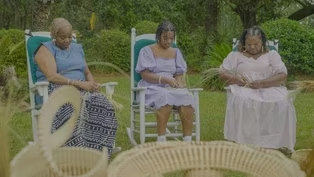
♪ I am Andrea Cayetano-Jefferson, a sixth-generation sweetgrass basket artist from South Carolina.
Narrator: There's no manual for making these baskets.
It's knowledge that's been passed down by the Gullah Geechee over generations.
Cayetano-Jefferson, voice-over: My mom and my aunt Linda taught me to sew baskets when I was very, very young, and their mom taught them, and I taught my daughter.
Ha ha ha!
Narrator: Many Gullah Geechee are descended from rice growers in West Africa, brought to the Atlantic coast as enslaved people more than 350 years ago.
They lived and grew rice and other crops on remote islands and in tidal areas from Florida to the Carolinas.
♪ Their distance from the outside world helped them to preserve their African heritage.
Hundreds of years later, many Gullah Geechee are still in this region and keepers of their unique culture.
They express it in the way they talk, dress, and eat and in their sweetgrass baskets.
Cayetano-Jefferson: Anyone can make a basket in that technique, but unless you're Gullah Geechee and you have that story behind it, I feel like that's what makes our baskets unique.
Narrator: Before starting a basket, Andrea goes out into the fields to collect plants like sweetgrass, bulrush, and pine needles.
Cayetano-Jefferson: When we go out to harvest the materials, it's usually mornings, and it starts very early... ♪ and a couple hours in the fields.
Then when you get home, we hang it out and dry it.
♪ Narrator: Weaving a basket-- or, as the Gullah Geechee say, sewing a basket-- is often a family affair.
Ha ha ha!
We're always laughing.
We're always laughing.
Narrator: Today Andrea is working with her cousin Theodora and her daughter Chelsea.
Chelsea, voice-over: It's just a great way to kind of bond, obviously, learn new practices and techniques, and, you know, I get a lot of history, of course, that I don't get to learn out anywhere else.
I like it.
Narrator: The women sew by using a nail bone, a kind of oversize needle, to help thread everything together.
Cayetano-Jefferson: So we go stitch for stitch, and I pull out my nail bone, and I put my palmetto through.
The Gullah word for palmetto is "mata," so when I'm putting my nail bone through, I'm pulling the nail bone out, and then I'm going to stick my mata right on through that same hole.
Narrator: Despite her passion for sewing baskets, Andrea almost gave up on it.
Cayetano-Jefferson: My grandmother had a third-grade education, and, for me, sewing baskets was-- it was called old lady work.
I'm 45, and there aren't many people my age who has been sewing baskets from a little child who has continued to do it every single day.
Narrator: In the end, Andrea realized that, for her, sewing was more than just a job.
It was her destiny.
Cayetano-Jefferson: If it's not me, then who will?
There's nobody else in the world like me to be here at this moment, so it has to be me.
The ancestors already set it up.
I'm just walking this path, girl.
I'm just walking this path.
Ha ha ha!
Narrator: The work is precise and methodical, with a basket taking weeks to finish.
Cayetano, voice-over: So once I get started in actually making a basket, I'll just keep going and going and going until I get tired, but actually getting up and actually, like, starting making the basket is my hardest part.
I love ending it, though.
Narrator: As Andrea pulls the final stitches, she always turns a critical eye on her work.
I am looking for any stray pieces.
I am looking for any pop stitches.
I am also looking for how symmetrical these are, so it's a lot of counting to make sure that each space is even.
Narrator: The end result is a basket sewn with care and a deep sense of devotion.
Cayetano- Jefferson: My Aunt Linda told me that sweetgrass baskets, it's not something that you have to do.
It's something that you want to do, and if you want to do it, you're going to do it right, and you're going to take your time and do it with love, and we do it with love.
♪ ♪ Narrator: America's artisans-- they are modern masters of the old ways.
♪ In a nation born of exploration... ♪ they're showing off the same spirit of discovery as their ancestors... ♪ firing the imagination with their passion as they write tomorrow's history etched in stone, told in song, crafted with care, and made with love.
♪ ♪
America Made with Love, Part 2 Preview
Video has Closed Captions
Discover the ingenuity, vision, and masterful talent of some of our most extraordinary artisans. (30s)
Providing Support for PBS.org
Learn Moreabout PBS online sponsorship

- News and Public Affairs

Top journalists deliver compelling original analysis of the hour's headlines.











Support for PBS provided by: